PDF · English
Theory of Objectification
A Vygotskian Perspective on Knowing and Becoming in Mathematics Teaching and Learning
Price and availability
$243.99
Available in: Andorra, Austria, Australia, Belgium, Bulgaria, Canada, Switzerland, Cyprus, Czechia, Germany, Denmark, Estonia, Spain, Finland, France, United Kingdom, Guernsey, Greece, Croatia, Hungary, Ireland, Isle of Man, Iceland, Italy, Jersey, Japan, Liechtenstein, Lithuania, Luxembourg, Latvia, Monaco, Malta, Netherlands, Norway, Poland, Portugal, Romania, Sweden, Slovenia, Slovakia, San Marino, United States, Vatican City, South Africa
Stores: US, UK, Canada, EU, Australia.
Sign in to buyThe price is re-checked by the server before payment.
For personal use under the eBook licence.
- Format
- DRM
- Not stated by the publisher
- Language
- English
- Publisher
- Brill
- Published
- 6 April 2021
- ISBN
- 9789004459663
- Subjects
- Moral & social purpose of education, School/community relations & school/home relations, Teaching of a specific subject, Educational: Mathematics & numeracy, Moral and social purpose of education, Educational administration and organization
About this book
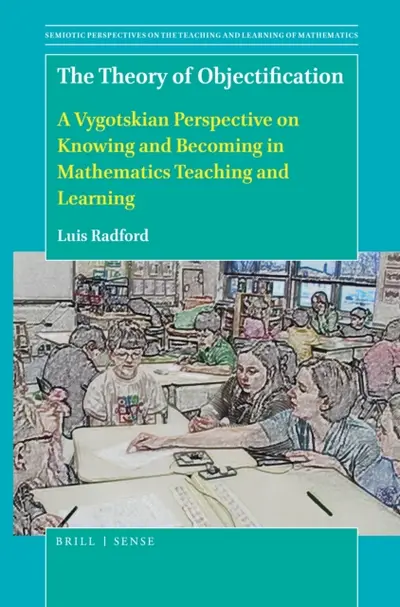
The Theory of Objectification: A Vygotskian Perspective on Knowing and Becoming in Mathematics Teaching and Learning presents a new educational theory in which learning is considered a cultural-historical collective process. The theory moves away from current conceptions of learning that focus on the construction or acquisition of conceptual contents. Its starting point is that schools do not produce only knowledge; they produce subjectivities too. As a result, learning is conceptualised as a process that is about knowing and becoming. Drawing on the work of Vygotsky and Freire, the theory of objectification offers a perspective to transform classrooms into sites of communal life where students make the experience of an ethics of solidarity, responsibility, plurality, and inclusivity. It posits the goal of education in general, and mathematics education in particular, as a political, societal, historical, and cultural endeavour aimed at the dialectical creation of reflexive and ethical subjects who critically position themselves in historically and culturally constituted mathematical discourses and practices, and who ponder new possibilities of action and thinking. The book is of special interest to educators in general and mathematics educators in particular, as well as to graduate and undergraduate students.
Bibliographic data © Gardners Books Ltd.