EPUB · English
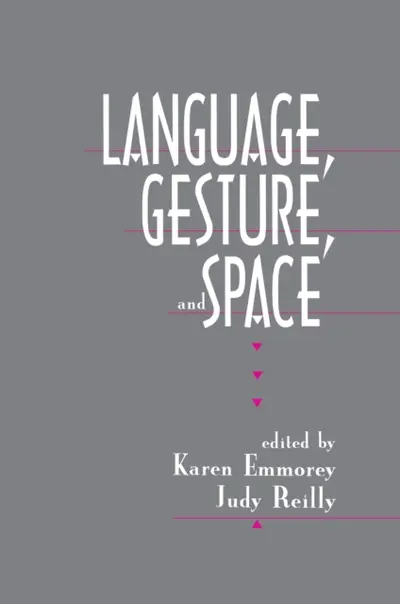
Language, Gesture, and Space
Price and availability
$74.99
Available in: Andorra, Austria, Australia, Belgium, Bulgaria, Canada, Switzerland, Cyprus, Czechia, Germany, Denmark, Estonia, Spain, Finland, France, United Kingdom, Guernsey, Greece, Croatia, Hungary, Ireland, Isle of Man, Iceland, Italy, Jersey, Japan, Liechtenstein, Lithuania, Luxembourg, Latvia, Monaco, Malta, Netherlands, Norway, Poland, Portugal, Romania, Sweden, Slovenia, Slovakia, San Marino, United States, Vatican City, South Africa
Stores: US, UK, Canada, EU, Australia.
Sign in to buyThe price is re-checked by the server before payment.
For personal use under the eBook licence.
- Format
- EPUB
- DRM
- Not stated by the publisher
- Language
- English
- Publisher
- Taylor & Francis
- Published
- 17 June 2013
- ISBN
- 9781134779734
- Subjects
- Psycholinguistics, Semantics, discourse analysis, etc, Discourse analysis, Sign languages, Braille & other linguistic communication, Semiotics / semiology, Psychology, Cognition & cognitive psychology, Language acquisition, Grammar, syntax and morphology, Sign languages, Braille and other linguistic communication
About this book
This book brings together papers which address a range of issues regarding the nature and structure of sign languages and other gestural systems, and how they exploit the space in which they are conveyed. The chapters focus on five pertinent areas reflecting different, but related research topics: * space in language and gesture, * point of view and referential shift, * morphosyntax of verbs in ASL, * gestural systems and sign language, and * language acquisition and gesture. Sign languages and gestural systems are produced in physical space; they manipulate spatial contrasts for linguistic and communicative purposes. In addition to exploring the different functions of space, researchers discuss similarities and differences between visual-gestural systems -- established sign languages, pidgin sign language (International Sign), "e;homesign"e; systems developed by deaf children with no sign language input, novel gesture systems invented by hearing nonsigners, and the gesticulation that accompanies speech. The development of gesture and sign language in children is also examined in both hearing and deaf children, charting the emergence of gesture ("e;manual babbling"e;), its use as a prelinguistic communicative device, and its transformation into language-like systems in homesigners. Finally, theoretical linguistic accounts of the structure of sign languages are provided in chapters dealing with the analysis of referential shift, the structure of narrative, the analysis of tense and the structure of the verb phrase in American Sign Language. Taken together, the chapters in this volume present a comprehensive picture of sign language and gesture research from a group of international scholars who investigate a range of communicative systems from formal sign languages to the gesticulation that accompanies speech.
Bibliographic data © Gardners Books Ltd.