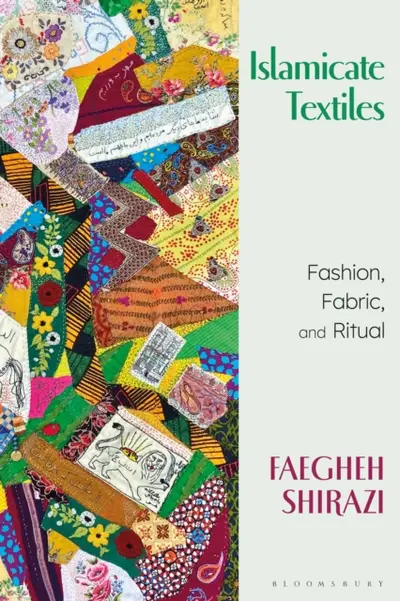
EPUB · English
Islamicate Textiles
Fashion, Fabric, and Ritual
Price and availability
$24.99
Available in: Andorra, Austria, Australia, Belgium, Bulgaria, Canada, Switzerland, Cyprus, Czechia, Germany, Denmark, Estonia, Spain, Finland, France, United Kingdom, Guernsey, Greece, Croatia, Hungary, Ireland, Isle of Man, Iceland, Italy, Jersey, Japan, Liechtenstein, Lithuania, Luxembourg, Latvia, Monaco, Malta, Netherlands, Norway, Poland, Portugal, Romania, Sweden, Slovenia, Slovakia, San Marino, United States, Vatican City, South Africa
Stores: US, UK, Canada, EU, Australia.
Sign in to buyThe price is re-checked by the server before payment.
For personal use under the eBook licence.
- Format
- EPUB
- DRM
- Not stated by the publisher
- Language
- English
- Publisher
- Bloomsbury Publishing
- Published
- 6 April 2023
- Pages
- 208
- ISBN
- 9781350291256
- Subjects
- Israel, History of art / art & design styles, Textile artworks, Industrial / commercial art & design, Fashion & textiles: design, History of fashion, Textile design & theory, Islamic life & practice, Material culture, Islamic studies, Textile arts and artworks, AGA, Design, Industrial and commercial arts, illustration, Fashion and textile design, JBCC2, JBSR, QRPP
About this book
Textiles and clothing are interwoven with Islamic culture. In Islamicate Textiles, readers are taken on a journey from Central Asia to Tanzania to uncover the central roles that textiles play within Muslim-majority communities.This thematically arranged book sheds light on the traditions, rituals and religious practices of these regions, and the ways in which each one incorporates materials and clothing. Drawing on examples including Iranian lion carpets and Arabic keffiyeh, Faegheh Shirazi frames these textiles and totemic items as important cultural signifiers that, together, form a dynamic and fascinating material culture. Like a developing language, this culture expands, bends and develops to suit the needs of new generations and groups across the world.The political significance of Islamicate textiles is also explored: Faegheh Shirazi's writing reveals the fraught relationship between the East with its sought-after materials and much-valued textiles and the European countries that purchased and repurposed these goods, and lays bare the historical and contemporary connections between textiles, colonialism, immigration and economics. Dr Shirazi also discusses gender and how textiles and clothing are intimately linked with sexuality and gender identity.
Bibliographic data © Gardners Books Ltd.